900 reference: Pedro routes
Every way to say where the robot should go, and which ones to avoid.
This project resolves com.pedropathing:core:3.0.1. Where the
documentation and the jar disagree, the jar is what is written here.
In the pictures the black line is where the robot drives and each red pin is
its nose, sampled every eighth of the way along. Both come from
Path.get(t) and Path.heading(t), so they are the library’s own
output rather than a drawing of it.
the shapes
A route is a shape plus a heading rule. There are four shapes.
Shape |
What it is |
|---|---|
|
A straight line between two poses. |
|
A Bézier curve. The first and last poses are the ends; every pose between them pulls the curve without being touched. |
|
A curve that passes through every pose given. |
|
Several paths run as one, in order. |
line
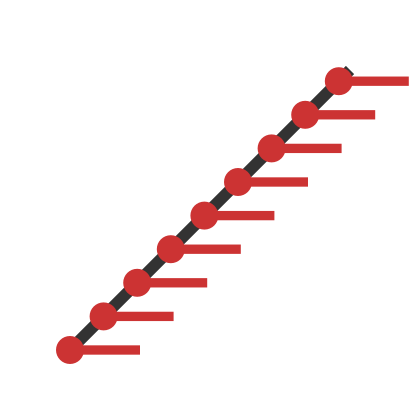
Two poses, nothing between them. line(start, end).constant(start) is the
plainest route there is and the one to reach for first.
curve
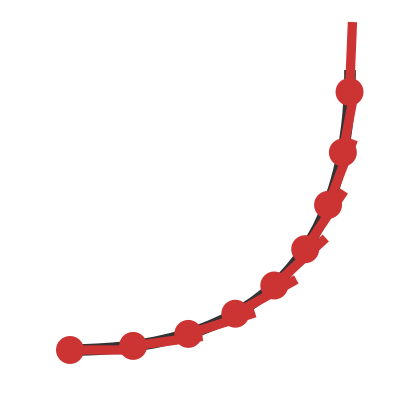
The control pose is a magnet, not a waypoint: the curve bends toward it and never reaches it. Its heading is ignored.
through
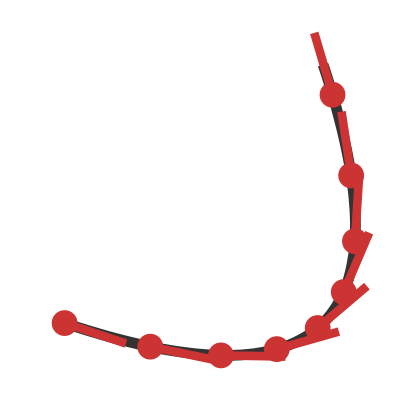
Every pose is on the route. The cost is at the ends: with tangent() the
nose starts at -18.4 degrees and finishes at 108.4 degrees on the same three
poses where curve runs 0 to 90, because the spline arrives at an angle.
Check the end heading rather than assuming it.
path
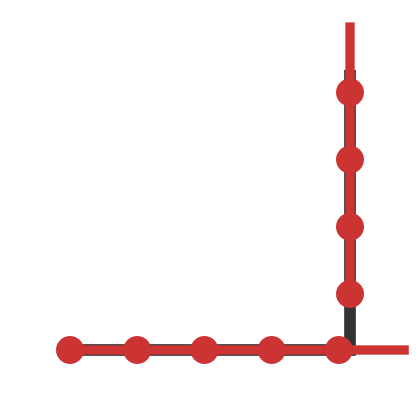
Two legs of a route, joined. The nose snaps at the corner rather than easing round it: measured 0 degrees for the first leg and 90 for the second, with nothing in between.
the heading rules
Rule |
What it does |
Use it? |
|---|---|---|
|
Holds that pose’s heading the whole way. |
Yes. |
|
The same, from a number. |
Careful: radians. |
|
Nose follows the direction of travel. |
Yes. |
|
Tangent plus 180 degrees, for driving backwards. |
Yes. |
|
Nose always aimed at one spot on the field. |
Yes, with one edge. |
|
Sweeps from one heading to another along the route. |
Yes. |
|
The same, taking the long way round. |
Yes, undocumented. |
|
A different rule on each stretch of the route. |
Not covered here. |
there is no default
The documentation says tangent() “is the default interpolation type when
you create a path”. It is not. A path with no heading rule throws as soon as
anything asks for a heading:
java.lang.UnsupportedOperationException: No heading interpolator set.
So every route needs a rule. It is not optional.
the number form is radians
constant(90) is not 90 degrees. It is 90 radians, which wraps to
116.6 degrees. constant(0) is safe only because zero is the same in both.
Two ways to avoid it. Pass a pose, constant(start), and the heading comes
from the pose. Or convert, constant(Math.toRadians(90)). A pose built by
PoseFactory.degrees() converts for you; constant does not.
linear() on a line was reversed before 3.0.1
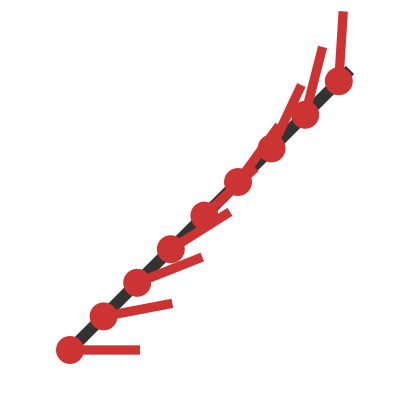
Asked to sweep from 0 to 90 degrees along a line, 3.0.1 does, and
endPose().heading() reports the end heading. 3.0.0 swept from 90 to 0 and reported the start heading. On
both:
on line(s, e)                     version    t=0   t=0.5    t=1
.linear(0, toRadians(90))         3.0.1      0.0    45.0   90.0
.linear(0, toRadians(90))         3.0.0     90.0    45.0    0.0
.linear(e, s), swapped            3.0.1     90.0    45.0    0.0
This was issue 176,
with 180 and
181 reporting the
same thing. The cause given there is Curve.pathCompletion() returning the
fraction of the path remaining rather than the fraction completed.
The workaround in those issues was to swap the arguments. On 3.0.1 the swap
turns the robot the wrong way, so a swapped linear() in code written for
3.0.0 is now a bug. On a curve, linear() is the same in both versions:
curve(s, m, e).linear(0, toRadians(90)) runs 0, 24.6, 45, 90.
longLinear() takes the long way round
longLinear(0, toRadians(90)) runs 0, 292.5, 225, then 90 at the end:
clockwise, the long way from 0 to 90. On 3.0.0 it was reversed the same way as
linear(), running 90, 157.5, 225, then 0. It is undocumented: the
documentation page lists tangent, linear, constant, facingPoint, piecewise and
custom, and not this.
facingPoint() has one edge
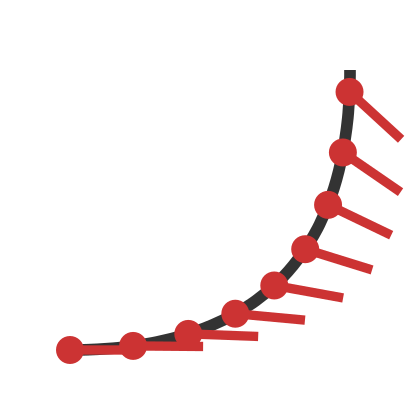
It works: the nose tracks the point as the robot moves. The edge is a route that
starts at the point it faces, where there is no direction to face. Measured on
a line leaving the point, the heading reads 0 at t=0 and the correct
-135 degrees from the next sample on, so the first instant is a discontinuity.
Issue 69 is about
this interpolator; it is closed.
what this page does not cover
Interpolator.piecewise(), which nothing here has run.Custom interpolators.
Deceleration, path and end constraints, and foresight, each of which has its own reference page and changes how a route is driven rather than what it is.
Whether any of this behaves on a floor. Everything above is the library’s own arithmetic, read out of the jar. When the simulator and the robot disagree, the robot is right.